
LVT vs Laminate vs Real Wood: Which Flooring Is Best for Your Home?
There's no single "best" flooring. LVT is highly water-resistant and ideal for kitchens, bathrooms, and over underfloor heating. Laminate is generally the most budget-friendly option for dry areas but lacks water resistance at the seams. Real wood offers unmatched lifespan and character but is moisture-sensitive, expensive, and solid wood cannot go over underfloor heating.
There's no single "best" flooring, whatever the adverts imply. LVT, laminate and real wood each solve different problems, and the right one depends on your subfloor, your budget, whether you've got kids or pets, and what room you're actually flooring. A material that's perfect for a busy hallway can be the wrong call in a bathroom, and a floor that looks identical to real oak in a showroom can behave completely differently once it's down.
This guide isn't a features list. It's a decision framework: what each material actually is, where each one holds up and where it doesn't, what fitting problems show up in real homes (not in manufacturer brochures), and which option suits which situation. By the end you should be able to match a flooring type to your actual room, rather than picking based on which one looked nicest online.
For general advice on luxury vinyl options, check our detailed LVT flooring article.
Key Takeaways
- LVT (luxury vinyl tile) is the most water-resistant of the three and works well in kitchens, bathrooms and over underfloor heating, but thin click-lock versions can fail on an uneven subfloor.
- Laminate is usually the cheapest option and can look convincing, but it's not genuinely waterproof at the seams and needs a proper expansion gap to avoid boards peaking.
- Real wood (solid or engineered) lasts the longest by a wide margin and can be resanded repeatedly, but solid wood isn't recommended over underfloor heating and both types are vulnerable to humidity-driven cupping and gapping.
- There's no reliable data proving any of these materials adds more resale value than another. Ignore claims that say otherwise.
- Installation method matters as much as the material itself: click-lock vs glue-down vs nail-down each carry different risks, and most of the "this floor failed" stories trace back to installation, not the product.
Quick Comparison at a Glance
| LVT | Laminate | Real Wood (Engineered) | Real Wood (Solid) | |
|---|---|---|---|---|
| Estimated lifespan | 15-20 years typical; up to 25-30 years for thicker wear layers (6-8mm) in low-traffic rooms | Varies by AC rating; generally shorter than LVT or wood in high-traffic use | 20-40 years, up to 50-80 years across 2-4 re-sands | 50-100+ years achievable with repeated sanding and refinishing |
| Water resistance | Good; many products cope with splashes and spills | Not genuinely waterproof, especially at seams | Moderate; better than solid but still moisture-sensitive | Poor; vulnerable to moisture from above and below |
| Underfloor heating | Generally good; check manufacturer's max surface temperature spec | Conditional; must be a UFH-rated product | Conditional; thinner boards preferred | Generally not recommended |
| DIY-fit difficulty | Click-lock: moderate, but unforgiving of an uneven subfloor. Glue-down: harder, but more reliable long-term | Reputation as "easy DIY," but expansion gaps and subfloor prep are easy to get wrong | Hard; usually a job for a specialist wood fitter | Hard; nail-down installation, usually a specialist job |
| Typical cost tier | Budget to mid | Budget (typically cheaper than LVT) | Premium | Premium |
All lifespan figures are industry-consensus estimates rather than independently lab-verified data. See the durability section below for context. If you are comparing general material costs including carpet options, see our LVT vs carpet cost guide.
What Is LVT?
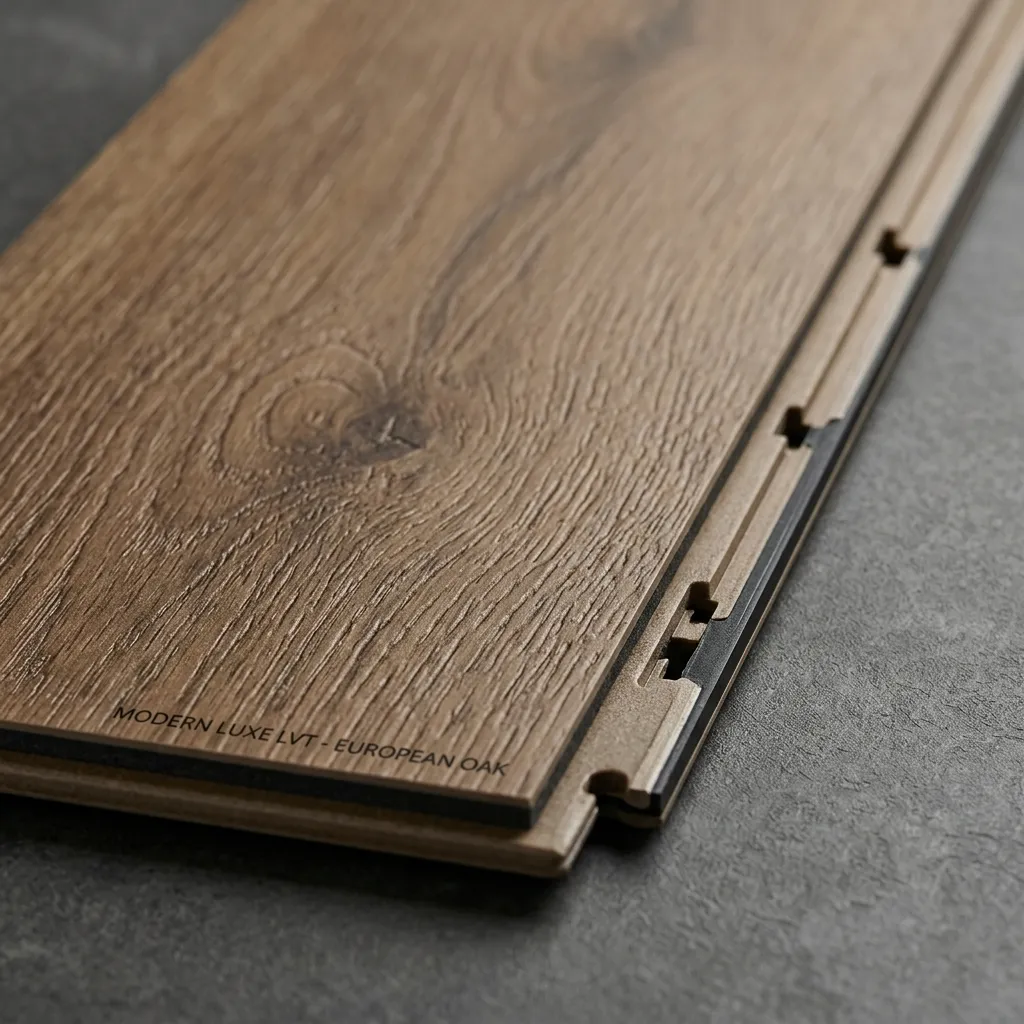
LVT (luxury vinyl tile) is a multi-layer synthetic flooring that replicates the look of wood or stone using a printed design layer under a protective wear layer, on a rigid or flexible vinyl core. It comes in click-lock planks that clip together without adhesive, or as sheets and tiles that are glued directly to the subfloor.
The appeal is straightforward: it looks convincing, it copes well with moisture, and it's generally more forgiving underfoot than a hard floor. That combination of realistic finish and practical water resistance is why it's become one of the most requested flooring types for kitchens, hallways and bathrooms in UK homes. Laminate and solid wood simply can't match it on the water-resistance side.
What Is Laminate?
Laminate flooring is a printed decorative layer fused under a hard, clear wear layer, sitting on a compressed fibreboard core that clicks together at the edges. It's rated under the EN 13329 European standard, from AC1 (light residential use) through to AC5 (heavy commercial). For a typical UK hallway or kitchen, AC3 is the recommended minimum.
Laminate's main selling point is price: it's usually the cheapest of the three options here and can produce a convincing wood-look finish from a distance. Where it comes unstuck is moisture and edge durability, which we'll cover in detail further down.
What Is Real Wood?
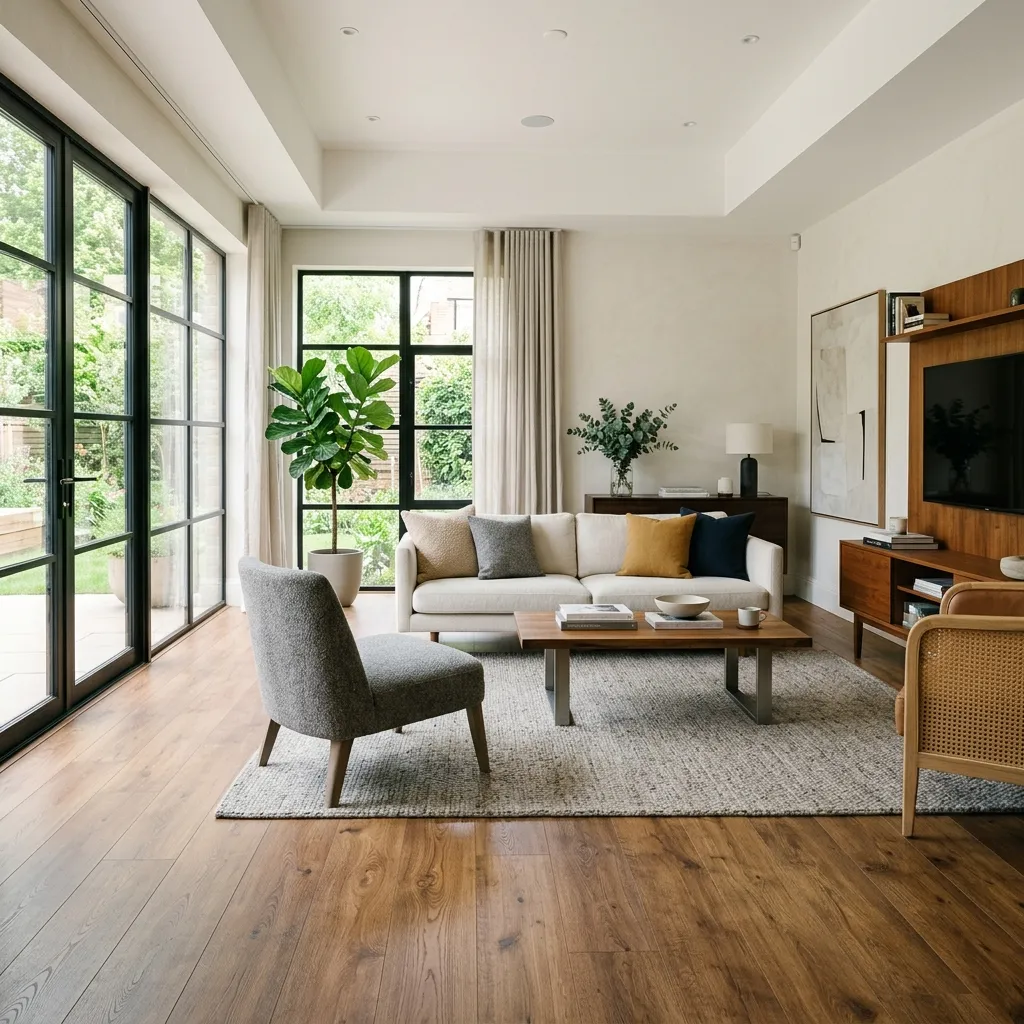
Real wood flooring splits into two distinct products that behave very differently, despite both being marketed as "wood floors."
Solid wood is exactly what it sounds like: a single piece of timber, typically 18-20mm thick, that can be sanded and refinished many times over its life. It moves with humidity more than any other flooring type here, which is the source of most of its long-term problems.
Engineered wood has a real wood veneer (usually 2-6mm) bonded to a plywood or high-density fibreboard base in cross-grain layers. This construction makes it more dimensionally stable than solid wood, which is why it's the wood option that can go over underfloor heating and works better in rooms with humidity swings.
Both can be resanded, though engineered wood can only be sanded as many times as its veneer thickness allows (typically 2-4 times), while solid wood can generally take more refinishes over its lifetime.

Durability & Lifespan Compared
Real wood outlasts LVT and laminate by a wide margin, largely because it can be sanded back to bare timber and refinished rather than replaced. Solid wood can realistically last 50-100+ years through repeated sanding, and engineered wood 20-40 years, stretching to 50-80 years across 2-4 re-sands of its veneer.
LVT sits in the middle. Industry consensus puts typical lifespan at 15-20 years, rising to 25-30 years for thicker wear layers (6-8mm) in lower-traffic rooms. It can't be sanded or refinished, so once the wear layer is damaged or worn through, the plank needs replacing rather than restoring.
Laminate's lifespan depends heavily on its AC rating and how it's treated. It can't be refinished either, and its wear layer is generally less forgiving of scratches and impacts than LVT's, particularly at lower AC ratings.
Estimated Lifespan Ranges (Years)
Source: Industry-consensus estimates (typical use, not independently lab-verified).
It's worth being upfront about the limits of these figures. None of these lifespan ranges come from an independently verified lab study; they reflect a consensus view across flooring trade sources rather than a controlled test. Treat them as a useful planning guide, not a guarantee.
Water Resistance
Where you can put each flooring type safely comes down to how it handles standing water and moisture at the seams, not just splashes.
LVT copes best with wet areas. Many products handle kitchen spills, bathroom splashes and even light basement moisture reasonably well, which is why it's become a common choice for those rooms. That said, "water-resistant" isn't the same as "flood-proof," and standing water left for extended periods can still cause problems at joints over time. For more information on wet zones, check our waterproof flooring article.
Laminate is not genuinely waterproof, despite some marketing suggesting otherwise. The seams between boards are the weak point: water that gets into a joint can swell the fibreboard core, causing permanent damage. This makes laminate a poor choice for bathrooms and a risky one for kitchens unless spills are cleaned up promptly.
Real wood, solid or engineered, is the most vulnerable of the three to moisture. Both are prone to damage from standing water and from moisture rising through the subfloor. This is a genuine concern in bathrooms and basements, and it's also the cause behind some of the least visible long-term failures, which we'll come back to in the homeowner regrets section.
Underfloor Heating Compatibility
LVT is generally the most underfloor-heating-friendly of the three, but "generally compatible" isn't the same as "compatible with any product off any shelf." Manufacturers set their own maximum surface temperature. A figure of around 27°C is commonly cited across the industry, but always check the specific product's manufacturer spec rather than treating that number as universal.
Engineered wood can work over underfloor heating, provided you choose a thinner board designed for the purpose. The cross-grain construction that makes engineered wood more stable also makes it better suited to the gentle, consistent heat cycling that underfloor systems produce, compared with solid wood.
Laminate can go over underfloor heating too, but only if the specific product is UFH-rated. Not all laminate is designed for it, and using a non-rated product risks warping or delamination.
Solid wood is generally not recommended over underfloor heating at all. Its higher susceptibility to expansion and contraction from heat and humidity changes makes it a poor match for a heat source built into the subfloor itself.
Fitting hard flooring over underfloor heating also requires the right type of dense, low-tog underlay (unlike standard carpet underlay, which is designed to insulate rather than conduct heat). For details on general underlay replacement and costs for carpeted rooms, see our guide on when to replace carpet underlay.
| Flooring Type | Underfloor Heating Compatibility | Key Requirement / Limit |
|---|---|---|
| LVT | ✔ Highly Compatible | Verify manufacturer's max surface temperature (often around 27°C). |
| Laminate | ⚠ Conditional | Must be a specifically UFH-rated laminate product and matching underlay. |
| Engineered Wood | ⚠ Conditional | Thinner engineered boards preferred for better thermal transfer. |
| Solid Wood | ✘ Not Recommended | Highly susceptible to shrinking, gapping, and cupping from direct heat source. |
What You'll Actually Pay
LVT and laminate both sit in the accessible-to-mid budget range, with laminate typically coming in cheaper than LVT for a comparable spec. Solid hardwood sits firmly at the premium end, and engineered wood usually falls somewhere between laminate/LVT and solid wood, depending on the veneer thickness and finish.
Those tiers only tell part of the story, though. Subfloor levelling and preparation can add meaningfully to the total cost of any flooring job, and it's often the thing that gets underestimated when someone's budgeting from a per-square-metre headline price alone. An uneven or damp subfloor doesn't care what material you've chosen; it needs sorting either way.
Labour costs also vary by region, and London and the South East typically run higher than the UK average for trade work generally, flooring and fitting included.
None of this replaces a proper quote. Real per-square-metre costs vary a lot depending on your property's subfloor condition, room shape, access, and the specific product you choose. Treat anything you read in a blog post, including this one, as a starting point for a conversation with a fitter, not a number to budget against directly.
Installation & Fitting Difficulty: What a Fitter Actually Sees Go Wrong
This is where the marketing and the reality diverge most, and it's worth spending time on because it's the part that determines whether a floor lasts or fails, whatever material you've picked. I fit carpet, LVT and vinyl day to day, so the LVT section below is drawn directly from that hands-on experience; the laminate and solid wood sections reflect what's well documented across the wider trade, not jobs I've personally fitted.
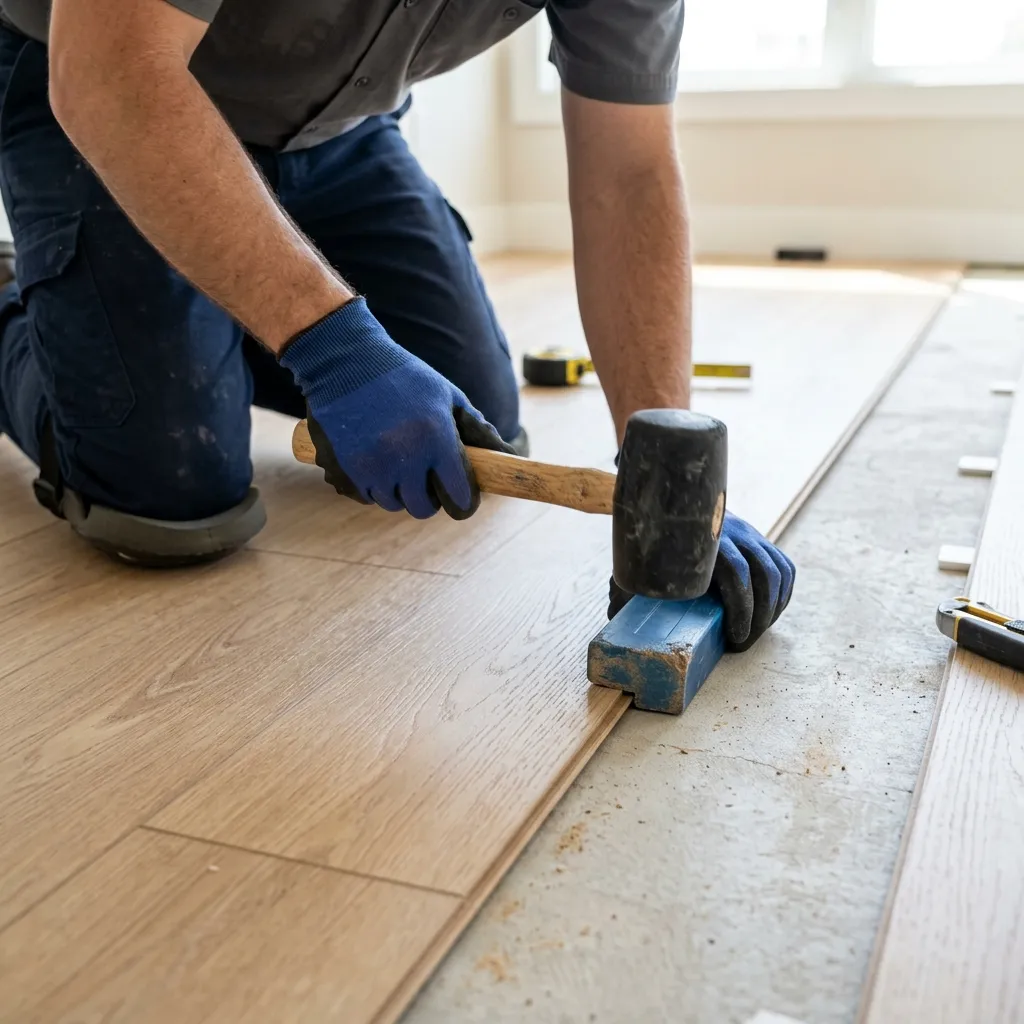
LVT's "DIY-friendly" reputation is only half true. Click-lock LVT is genuinely easier to handle than glue-down, and plenty of people fit it themselves successfully. But thin click-lock planks are unforgiving of an uneven subfloor: the joints can snap or separate under foot traffic if the base beneath them isn't flat. Glue-down LVT is harder to install and less commonly attempted as a DIY job, but it's often the more reliable choice long-term because the adhesive bond, not a mechanical click, is what's holding the floor together. The tolerance for subfloor variation on a glue-down job is tight: no more than around 2mm over a 2-metre span. The planks also need to acclimatise for 48 hours at 18-26°C before laying. For a deeper look at fitting methods, review our click-lock vs glue-down LVT article.
Laminate's reputation as "the easy DIY option" is somewhat overstated. Jewson, a major UK builders' merchant, states plainly that "laminate flooring should never be installed by a DIY novice," which runs against the popular perception. The most common fault flagged across the trade is a missed or insufficient expansion gap, generally needed at 6-10mm around the room's perimeter. Skip that gap or get it wrong, and the boards have nowhere to move as temperature and humidity shift, which causes peaking: boards lifting and separating at the seams, sometimes months after the floor went down and looked fine.
Solid wood's installation mistakes often don't show up for months. Nail-down solid wood flooring depends on getting moisture content, acclimatisation and fixing spacing right at the time of laying. Get any of that wrong and the floor can look perfect on day one. Problems like cupping, gapping or squeaking often only appear later, once the room's gone through a full heating season or a change in humidity. That delay is what makes solid wood installation genuinely tricky: by the time a problem is visible, it's often too late to fix cheaply. This isn't a job I take on myself, since it falls outside carpet, LVT and vinyl fitting, but it's worth understanding before you commit to solid wood.
The pattern across all three materials is the same: the failures that homeowners complain about almost always trace back to installation, not the product itself. A well-fitted budget floor generally outperforms a premium product installed badly.
What Homeowners Actually Regret
Homeowner forum discussion gives a useful, if informal, read on where things go wrong in practice, even though it isn't formal survey data.
On a MoneySavingExpert thread comparing LVT and laminate, one contributor warned that click-lock LVT joints measure as little as 2.2mm at their narrowest point and that "any movement risks the thin 'click' joints breaking," recommending a level subfloor and, ideally, glue-down installation for reliability instead. A separate poster on the same thread advised against laminate, saying it "gets damaged easily, not waterproof and generally looks artificial."
On a Houzz discussion thread, a homeowner describes hardwood flooring, three years old in one room and twelve years old in an adjoining room, becoming visibly uneven. The cause traced back to moisture getting into the subfloor from below, not anything visible at the time of installation, after unrelated work changed conditions under the floor. That thread is from a US-based homeowner rather than a UK one, but the underlying failure mode, moisture reaching timber from below rather than from spills above, applies just as much to a UK subfloor. It's a useful illustration of a point worth taking seriously: wood's failure modes are often invisible until well after the job is finished and the fitter's long gone. To understand more about damp proofing and subfloor surveys, see our guide on subfloor moisture testing.
None of this is formal data, and it shouldn't be read as such. But it lines up closely with the installation issues covered above, and it's exactly the kind of real-world signal that a features list or spec sheet won't give you.
Which Should You Choose?
There's no universal winner here, but matching the material to your actual situation narrows things down quickly.
Renting or planning to move within a few years. LVT tends to make the most sense: it's water-resistant, reasonably priced, and doesn't demand the long-term commitment that a premium wood floor implies. If you are a landlord or preparing a rental property, review our details on choosing flooring for a rental property.
Homes with kids or pets. LVT again has the edge, mainly because of its water resistance and general resilience to the kind of spills, scratches and general wear that come with a busy household. Laminate can scratch and dent more easily, and both wood options carry moisture risk if drinks get spilled or pets have accidents.
Period or character homes. Real wood, particularly engineered wood in older properties with variable subfloors, often suits the character of the building better and can be a genuine long-term investment given how long it lasts and how many times it can be resanded.
Tight budgets. Laminate is usually the cheapest route to a convincing wood-look floor, provided you're realistic about its water resistance limits and stick to at least AC3 for anything beyond a low-traffic room.
Prioritising resale value. Here's a straightforward gap worth naming rather than papering over: there's no credible, findable data proving that real wood, LVT or laminate adds more resale value than another. Claims to that effect circulate widely across flooring sites, but the evidence behind them doesn't hold up to scrutiny. If resale is genuinely your priority, a well-maintained, well-fitted floor of any of these three types is a more defensible bet than chasing a resale premium that isn't backed by real data.
If you've landed on LVT after weighing this up, subfloor condition is the detail that actually determines how the job goes, and it varies a lot by property type and area. I cover this in more local detail on the dedicated LVT pages for Reigate, Oxted, Beckenham, Croydon and Tunbridge Wells, including the subfloor issues that come up most often in each area's housing stock.
Frequently Asked Questions
Is LVT actually waterproof?
Can laminate go in a bathroom?
Can I fit LVT myself?
Which lasts longest?
Do I need special underlay for underfloor heating?
Is real wood always better for resale?
Areas I Cover
Based in South London, covering Surrey, Kent and Sussex with the mobile showroom:
The Bottom Line
- LVT suits wet rooms, busy households and underfloor heating best, provided the subfloor is properly prepared or the installation method matches the product. For comparison, check out our professional LVT installation services and review our LVT vs vinyl flooring comparison.
- Laminate is the budget-friendly option for a convincing wood look, but keep it out of bathrooms and don't skimp on the expansion gap.
- Real wood lasts the longest and can be resanded repeatedly, but it's the most moisture-sensitive option and solid wood shouldn't go over underfloor heating.
- Installation quality determines how any of these floors performs over time far more than the marketing around the material itself.
Match the material to your room, your household, and your budget rather than to whichever floor looked best in a showroom photo. If you've read through this and you're leaning towards LVT, carpet or vinyl for a home in South London, Surrey, Kent or Sussex, that's the work I do day in, day out (offering dedicated carpet fitting, LVT installation, sheet vinyl fitting, and labor-only fitting services): no subcontractors, no shopfront overheads, just 20+ years of hands-on experience (read more about Paul here) and a mobile showroom that comes to you. Feel free to contact me or call 07903 320 414 for an honest quote.
If you're leaning towards laminate or real wood, you'll want a specialist fitter experienced with that specific material, since it falls outside the fitting work I take on.
Get Your Exact Price
Three fields. Paul replies personally — usually within the hour, always the same day.
Prefer WhatsApp? Send a photo of your room to 07903 320 414 for a faster estimate.